8th Pay Commission Salary 2026 is the most searched topic among central government employees today.
Kitna milega — that’s really the only question anyone’s asking. So let’s start there.
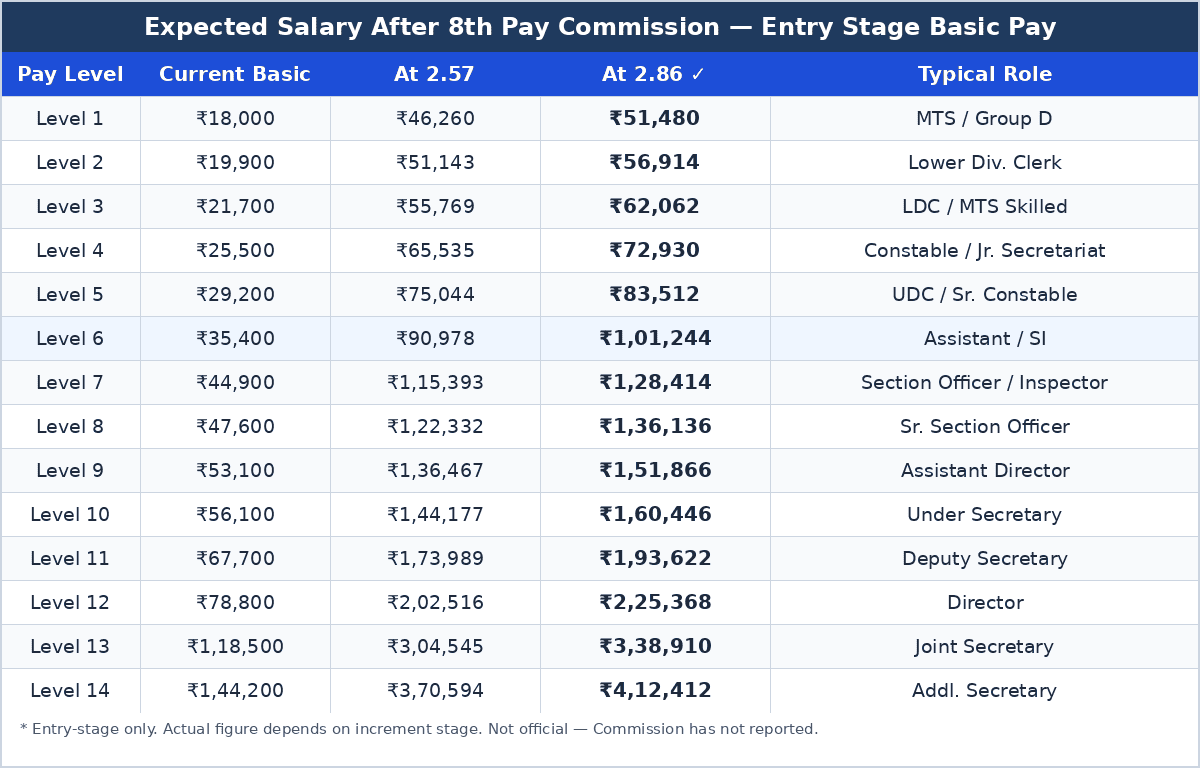
At a fitment factor of 2.86, a Level 6 employee on ₹35,400 basic moves to roughly ₹1,01,000. Level 1 MTS on ₹18,000 goes to around ₹51,480. These aren’t official — the Commission hasn’t reported yet — but they’re grounded in analyst consensus, not the kind of WhatsApp screenshot that circulates every few weeks with no source attached.
The when is the bigger problem, and that’s where most of the confusion lives.
What’s Actually Confirmed — and What Isn’t
Those salary posts going around aren’t always wrong exactly. They’re mixing up two dates. The effective date and the implementation date sound related but mean completely different things, and nobody sharing those posts bothers to explain the gap.
Here’s what’s confirmed as of April 2026: Cabinet approved the 8th Pay Commission on January 16, 2025. Formally constituted November 3, 2025, chaired by Justice Ranjana Prakash Desai, with Prof. Pulak Ghosh and Shri Pankaj Jain IAS as members. Eighteen months to consult, study, and report. Notional effective date: January 1, 2026.
“Notional effective date” sounds more decisive than it is. It means arrears will be calculated from January 1, 2026 — whenever revised salaries are finally notified. Your salary itself didn’t change that day. The Commission hasn’t even submitted its report yet. After it does, the government reviews, negotiates, notifies, departments implement. That whole chain realistically points to revised salaries arriving in 2027, with arrears paid alongside.
The 7th CPC moved in six months from effective date to implementation — people cite this constantly while forgetting it was a complete outlier. The 6th CPC took 32 months. Eighteen to 24 months from January 2026 is the honest estimate for the 8th.
The Fitment Factor — What 2.57, 2.86 and 3.0 Actually Mean
A multiplier applied to your current basic pay to produce your new basic. If you’re at ₹44,900 and the factor is 2.86, new basic is ₹1,28,414. Arithmetic’s simple. What’s less simple — and where most internet excitement is genuinely misplaced — is understanding what’s inside that number.
A significant chunk of any fitment factor isn’t new money. It’s absorbing DA that’s accumulated over a decade. Dearness Allowance currently sits at 60% of basic, and when the new structure kicks in, that 60% gets folded into the revised basic through the fitment factor. DA then resets to zero on the higher base. You haven’t lost it — it’s been restructured — but the multiplier is doing two jobs at once, not one.
The 7th CPC illustrates this. Fitment 2.57, DA at 125%. Someone on ₹10,000 basic was already drawing ₹22,500 effectively. Post-fitment new basic: ₹25,700. Actual gain: ₹3,200 — about 14.3%. Technically accurate headline, practically misleading.
DA today is 60%, not 125%, so the 8th CPC real gain will be better than the 7th’s. But triple your take-home? That’s not what this is.
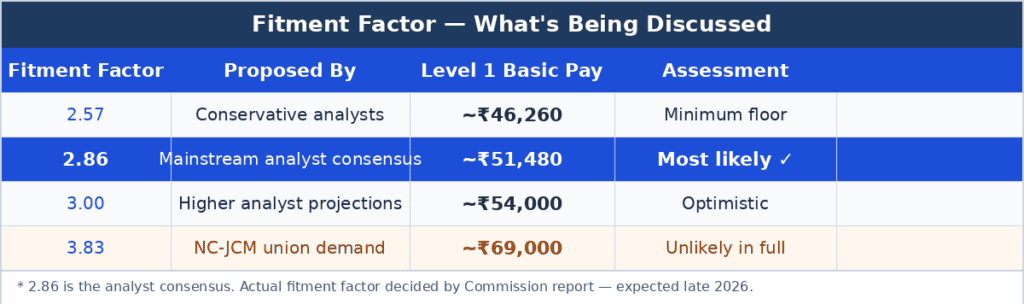
The NC-JCM filed a 51-page memorandum in April 2026 — proper document, updated ILC norms, five-member family calculations. Their 3.83 figure isn’t arbitrary. But the approved number has always landed considerably below what unions demanded. Somewhere between 2.57 and 2.86 is where serious analysis clusters. Above 3.0 would be a better outcome than history predicts.
Expected Salary — All Pay Levels 1 to 14
Entry-stage figures at both main fitment scenarios. Your actual number depends on increment stage within your level, not just the level itself — someone at Level 6 stage 5 gets a different result than stage 1.
DA Resets to Zero — This Isn’t What It Sounds Like
Most people hear this and assume something’s being taken. It isn’t.
Your 60% DA gets absorbed into the new basic pay through the fitment factor — same money, different structure. DA then restarts at zero on a much bigger base and climbs back up through twice-yearly revisions, January and July, same AICPI-IW mechanism that’s always applied.
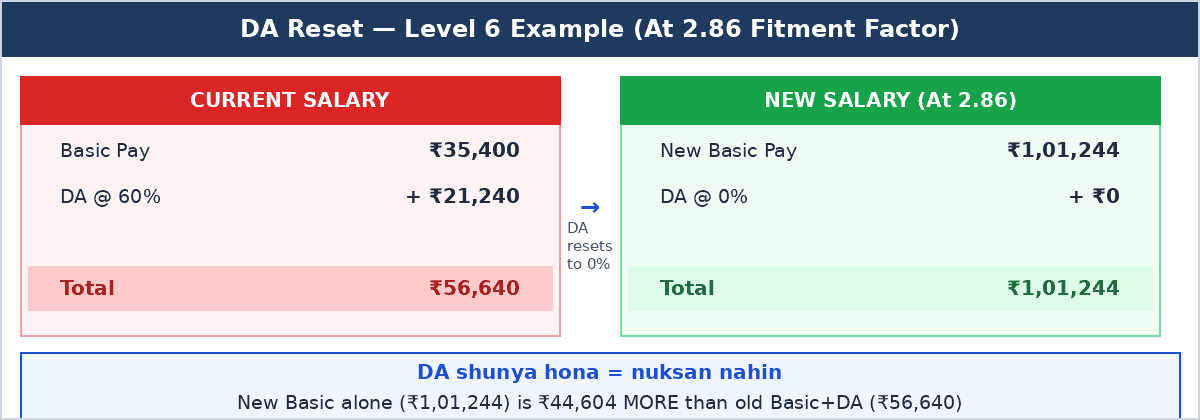
New basic, before DA has started building again, already clears the old basic-plus-DA by nearly ₹45,000. HRA and Transport Allowance — percentage-linked to basic — recalculate upward automatically, no separate order needed.
What About Pensions
Same logic as salaries. Existing pensions get multiplied by the approved fitment factor. Dearness Relief resets to zero on the revised figure, then climbs again from there.
Minimum pension moves from ₹9,000 to around ₹23,130 at 2.57 or ₹25,740 at 2.86. Family pension follows the same revision.
If you’re on the Unified Pension Scheme — launched April 1, 2025 — the assured 50% pension gets recalculated on the new higher basic. Real improvement, not theoretical. NPS subscribers don’t get a guaranteed number, but higher basic means larger monthly contributions from both sides compounding over remaining service years. Slower benefit, less visible, but real.
On OPS restoration — unions are demanding it at 67% of last drawn pay. Government hasn’t moved. Nothing in the Commission’s proceedings suggests it’s reconsidering.
The Timeline Pattern — 6th, 7th, 8th
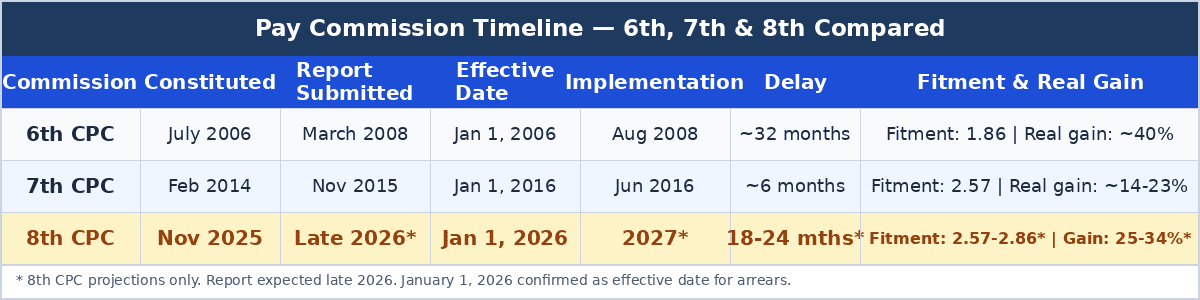
The 6th CPC row is worth sitting with. Fitment of 1.86 — much lower than the 7th’s 2.57 — and yet real salary increase was around 40%. DA was only ~50% at the time, so most of that fitment was genuine new money rather than DA absorption. Come 2016, DA had climbed to 125% and consumed most of the 2.57 multiplier. Net real gain: 14.3%.
The 8th CPC with DA at 60% sits between those two situations. The 25–34% projected real gain reflects that. Meaningful — just not what the viral calculators suggest.
Two things have held without variation across every commission: effective date is always January 1, and arrears are always paid from it. The 8th won’t be different.
Questions People Keep Asking
Will salaries change in 2026?
No. Commission is still in consultations as of April 2026, report expected late 2026 at the earliest, then government review. Realistically, revised salaries reach accounts in 2027 with arrears backdated to January 1, 2026.
Which fitment factor will actually be approved?
Nobody outside the Commission knows. What consistent analysis supports: 2.57 to 2.86. Use 2.57 for conservative planning, 2.86 as the better-case. NC-JCM’s 3.83 is a legitimate negotiating position, not a forecast.
How much in arrears — and is it guaranteed?
Every Pay Commission in India’s history has paid arrears from the effective date. Rough estimates: Level 1–3 around ₹3–5 lakh, Level 7–9 maybe ₹5–8 lakh, higher levels potentially ₹10 lakh and above. Shifts substantially based on final fitment factor and how long implementation runs.
Does HRA go up automatically?
Yes — it’s a percentage of basic, so it rises when basic rises, no separate order needed. The Commission will also recommend revised rates. Currently 24/16/8% for X/Y/Z cities, NC-JCM wants 40/35/30%. Reality will land somewhere between those.
State government employees — does this cover them?
No. Central employees, defence personnel and central pensioners only. States run their own revisions, most eventually follow the central structure but typically a year or two behind.
I’m on NPS — what changes?
Higher basic means larger monthly contributions from both your side and the government’s, compounding over remaining service years. No guaranteed number like OPS or UPS, but the retirement corpus outcome improves — especially if you have a decade or more left.
Before You Go
Check your payslip and note your exact basic pay as of January 1, 2026 — the actual figure at your increment stage, not just the level. That’s what arrears will be calculated on, and a lot of people don’t know it off the top of their head.
Don’t borrow against the revision. It’s coming, but 2027 is the floor and things can slip further. For updates, look for sources that can point to an actual document — a PIB press release, a gazette notification, something traceable. The misinformation around the 8th CPC is already substantial and will get worse closer to implementation.
Disclaimer: All figures are analyst projections based on historical Pay Commission patterns — not official data. The 8th Pay Commission has not submitted its report. Don’t make major financial decisions based on projections.
© YojnaDost.com | Last Updated: April 2026